Makeup, Masks, Hats or Glasses: What Actually Works Against Facial Recognition?
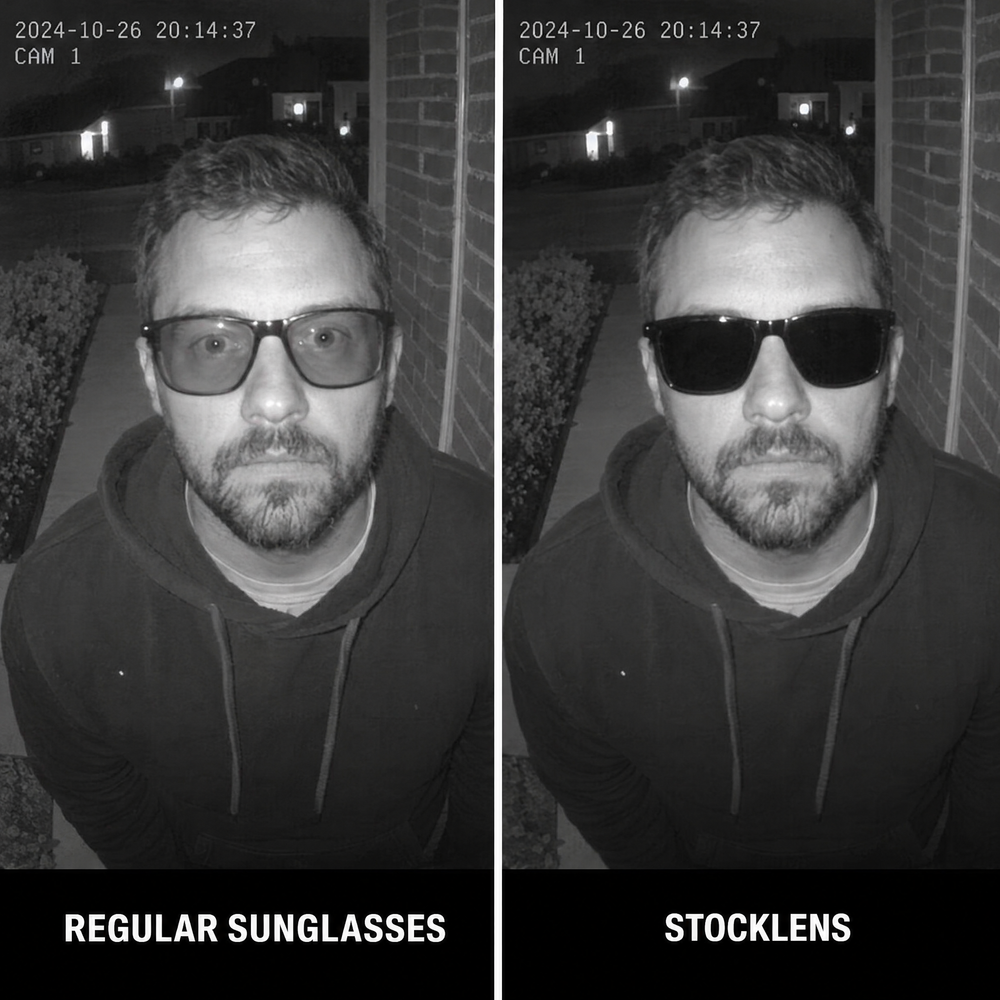
Ask ten people how to avoid facial recognition and you'll get ten answers: a hat, a mask, a hoodie, "that weird makeup," a pair of sunglasses. Some of these help. Most of them stop helping the moment a camera switches to infrared, which a lot of them do, all day and all night.
Here's a plain-English look at each option.
First: how cameras actually read a face
Face recognition software measures your face. It maps landmarks, mostly the eyes, brow, nose and jaw, and turns the distances between them into a numeric fingerprint. The eye region carries a huge share of that information, which is why covering it matters more than covering anything else.
The other thing to know: many security cameras, doorbells, plate readers and phone face-unlock systems use near-infrared light. You can't see it. The camera can, and it lights up your face in it even in the dark.
Hats and brims
What helps: a brim casts shadow and blocks cameras mounted above you, which is a lot of them. It's normal-looking and costs nothing.
What doesn't: it does nothing for cameras at eye level or below, like doorbells, store entrances and dashboards. Infrared cameras often see right through shadow.
Verdict: a good layer. Not enough on its own.
Face masks
What helps: masks hide the nose, mouth and jaw.
What doesn't: modern systems were retrained on masked faces and lean even harder on the eyes, which a mask leaves fully exposed. Masks also draw attention in a lot of places now, and some stores ask you to remove them.
Verdict: covers the wrong half of your face.
"Anti-face" makeup and patterns
What helps: bold geometric makeup can confuse some older detection systems in lab conditions.
What doesn't: results on modern systems are inconsistent, it's impractical for daily life, and it makes you the most noticeable person in any room.
Verdict: fun art project. Not an everyday solution.
Regular sunglasses
What helps: in normal daylight, dark lenses cover the eyes, the single most important region for a match.
What doesn't: ordinary lenses, polarized and mirrored ones included, only block visible light. Under near-infrared they go almost clear, and the camera sees your eyes as if you weren't wearing anything. You can test this at home: most phones will still unlock with Face ID while you wear normal sunglasses.
Verdict: they look like they work. On an IR camera, they don't.
IR-blocking sunglasses
This is what we make, so take this section with that in mind. A lens like our IRX filters near-infrared (99%+ on our lens) as well as UV. On an infrared camera the lenses read as solid black, so the eye region stays covered in both visible and IR light. Most phones won't unlock with Face ID while you wear them, which is an easy way to check.
They won't make you invisible, and no pair of glasses can promise you'll never be identified. But they cover the part of your face recognition depends on most, in the light the cameras actually use, and they look like a regular pair of sunglasses.
The best setup
- IR-blocking sunglasses for the eyes
- A brim for overhead cameras
- Don't linger directly under fixed cameras
- Free steps first: turn off the tracking you control. Our guide Your Day, On Camera walks through all six stops of an ordinary day.